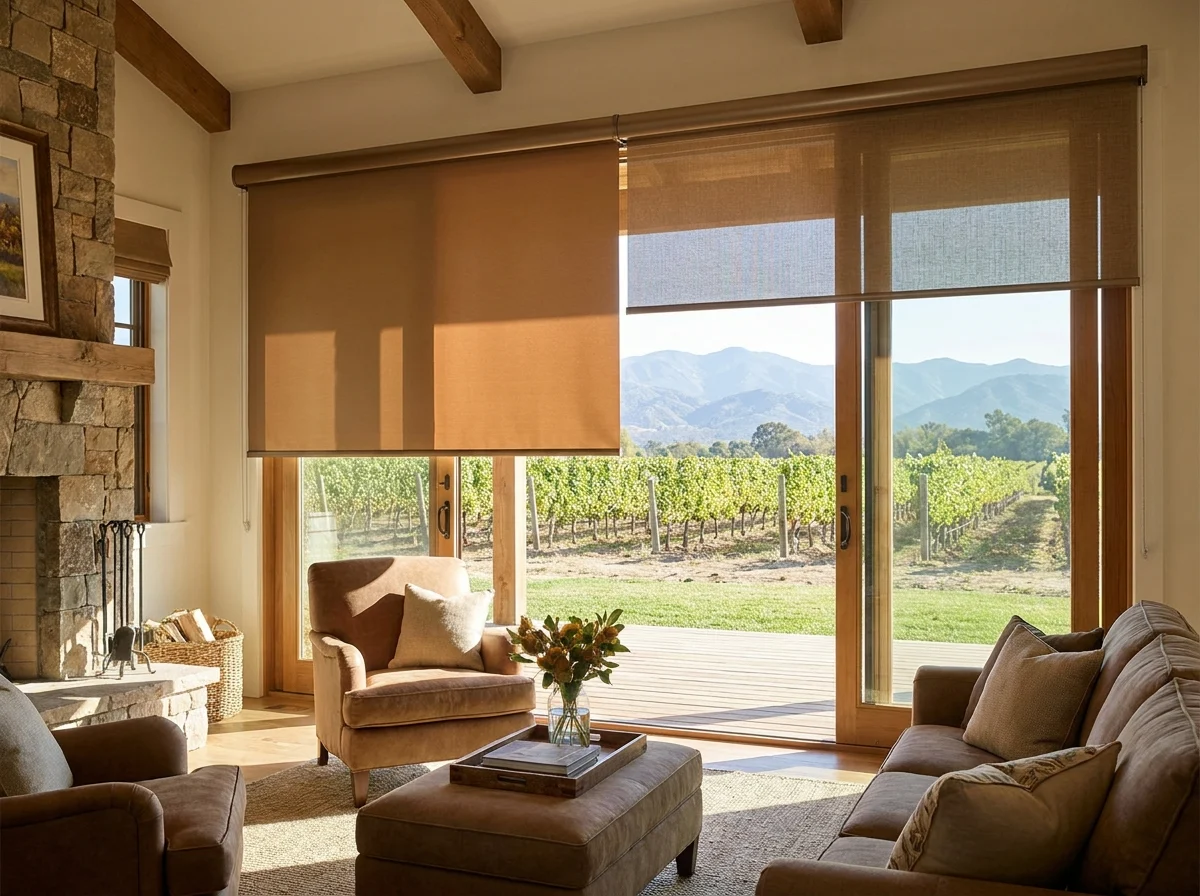
Blockout stops light completely — right for bedrooms, nurseries and any room that needs proper darkness through a valley afternoon that doesn't cool off on its own. There's a genuine thermal benefit too: an insulating layer against both a trapped summer and a cold, damp winter night on a solid-wall farmhouse.
Sunscreen mesh (3%, 5% or 10% openness) cuts glare and UV while keeping the vineyard rows in view — the standard answer for the wide glass a new farmstead home is often built around. On the west- or north-facing side of the house, where the valley's reduced evening wind relief lets heat linger longest, a lower openness earns its keep; 3–5% is the usual view-preserving choice elsewhere. Worth knowing: sunscreen gives daytime privacy but reverses after dark, when lights on inside make the room visible from the farm road — worth pairing with curtains or a second roller in a bedroom.
Light-filtering / translucent fabric softens daylight and gives full privacy without a view — a middle ground for bathrooms or rooms facing a working farm road.
They're the right call for new farmstead glass, wine-estate living rooms and anywhere you want an easy-clean, budget-to-premium fabric that also wipes down easily after a dusty harvest week. On a century-old werf home's small deep-set sash, a timber venetian usually reads more at home — we'll say so plainly at the measure rather than sell the wrong product for the window.
Sunscreen rollers keep the vine-row view honest on the wide glass walls going up around Groot Drakenstein and Simonsvlei, go blockout for bedrooms on the older farmhouses of Simondium, and run a double roller on the family homes near the Klapmuts crossroads where a bedroom still wants light by day and full dark by night.
Take it as a rate for a square metre of blind, fitted and working. Chain-driven rollers sit between R1,000 and R1,600 that way — standard blockout toward the bottom, a view-holding sunscreen or a twin bracket carrying two cloths toward the top. Add a tube motor and the rate sits between R2,500 and R3,800, motor, control and the day’s setting-up included.
The rate stops holding on very small openings: a scullery window eats the same tube, brackets and ladder time as a homestead lounge, so those carry a minimum. A rate is also not a quote — every opening is priced on its own after the free measure and set down on paper before manufacture.
Ready when you are
Send the form and one of our expert consultants will contact you shortly to arrange your free in-home measure.
Request my call-back →| Best for | New farmstead glass, estate living rooms and bedrooms |
|---|---|
| Light control | Sunscreen at 3, 5 or 10 percent, translucent, or blockout |
| Privacy | Sunscreen is see-through from the farm road once lights are on |
| Operation | Chain with wall-anchored tensioner, spring-assist or motor |
| Mounting | In the reveal, or over the opening for a darker bedroom |
| Care | Wipes clean; expect to do it more often during harvest |
Considerably less. Indoor roller blinds sit at the bottom of the valley-wide range, with a standard blockout the least expensive and a sunscreen or a twin bracket carrying two cloths toward the top of the roller band. Shading outside the glass costs more than anything else fitted here. The two are not substitutes, though: indoor fabric handles glare, privacy and how the room looks, and exterior shading handles heat. The rates are set out on the pricing page, and each opening is priced separately on paper after the free measure.
It depends on what the room is for. Inside a deep reveal a roller looks neat and leaves the old plasterwork and timber trim on show, which suits living rooms. In a bedroom, fitting it over the opening is dramatically darker, because the light that wakes people in January comes round the edges of the blind, not through the cloth. On a building old enough to raise heritage questions, the inside fit is also the least intrusive, since the opening itself is not altered.
For most view glass, 3 to 5 percent is the usual choice: open enough to see the vineyard clearly, tight enough to take the hard edge off the light. On the west or north side of the house, where the valley's lack of evening wind lets heat hang on, the lower end of that range earns its keep. A 10 percent weave shows more but controls less. A pale mesh softens glare bouncing back from a bright vineyard. Remember that any sunscreen is a glare tool; it does not replace shade outside the glass.