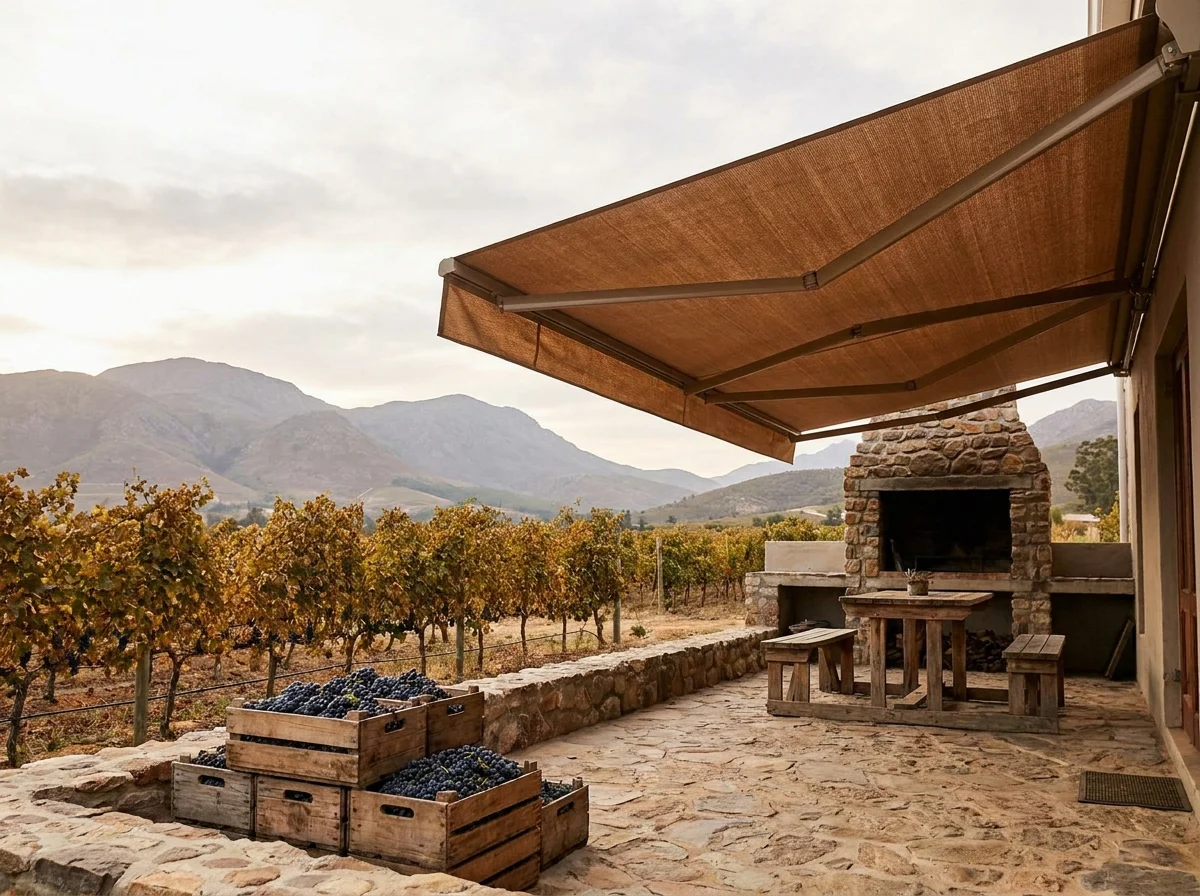
A north- or west-facing stoep can go from unusable to genuinely comfortable the moment the fabric extends — and retract it again in winter for the low sun a fixed roof would block outright. No posts means no interrupted vineyard view and no clutter around a braai area. Projection runs to roughly 3–4m over wide spans, and solution-dyed acrylic fabrics hold their colour under Cape UV.
This is a shade product, not a rain product — light drizzle at a pitch is fine, standing rain or a real storm is not. Wind ratings are real limits, not suggestions, particularly on an exposed valley-floor stoep with no windbreak. Fixing substrate matters too — brick, timber or steel each need their own check, done properly at the measure rather than assumed.
Harvest-season entertaining patios near the werf homesteads of Groot Drakenstein and the crossroads farmhouses of Simondium are where we fit these most, almost always motorised with a wind sensor given how little shelter either area gets from the surrounding slopes.
An awning is rated on projection — width along the wall times the reach of the arms — fitted and working. Crank-operated: R3,500 to R5,500 for a square metre of that projection, rising with the span and with a full cassette over an open frame. With a motor and a wind sensor, which a valley elevation genuinely wants: R5,500 to R7,500.
Short projections carry a minimum, since a small awning still needs full arms, proper brackets and a look at what is behind the fascia. The stoep is measured, the fixing checked and the number set down for you afterwards, at no cost.
Ready when you are
Send the form and one of our expert consultants will contact you shortly to arrange your free in-home measure.
Request my call-back →| Best for | North or west stoeps and braai tables with a vineyard view |
|---|---|
| Wind or weather | Shade only; retracts by sensor before a gust, never left out overnight |
| Operation | Crank, or motor with wind sensor as the valley norm |
| Mounting | Brick, timber or steel, each checked at the measure |
| Fabric | Solution-dyed acrylic, colour-fast in Cape sun |
| Extras | LED lighting and a vertical drop valance on premium lines |
Because the weather that damages awnings here gives little notice. Gusts funnel down off the slopes on afternoons and evenings that felt dead still minutes earlier, and a berg wind can come up ahead of a cold front while the household is asleep or away. A wind sensor retracts a motorised awning unprompted, and that is fitted as the norm. Even so, the working rule in this valley is that nothing outdoors is left down overnight as a matter of habit, motorised or not.
Often a compact one. On working farms such as those around Simondium, entertaining tends to happen close to the house and not on a separate deck, so the awning only has to cover a table and the chairs round it. The width follows the wall available and the reach follows how far the table sits from it, up to roughly three to four metres. A small awning still needs full arms and proper brackets, and the wall behind the fascia is checked before any size is put on paper.
Its winter use is mostly to get out of the way. In June the midday sun here is only about 33 degrees up, and that low light on the stoep is something most people want. A fixed roof would block it; a retracted awning does not. It is not a rain shelter: light drizzle at a pitch is fine, standing rain or a real storm is not. For a stoep you want to sit on through a wet winter, clear-panel zip screens at the sides do more.