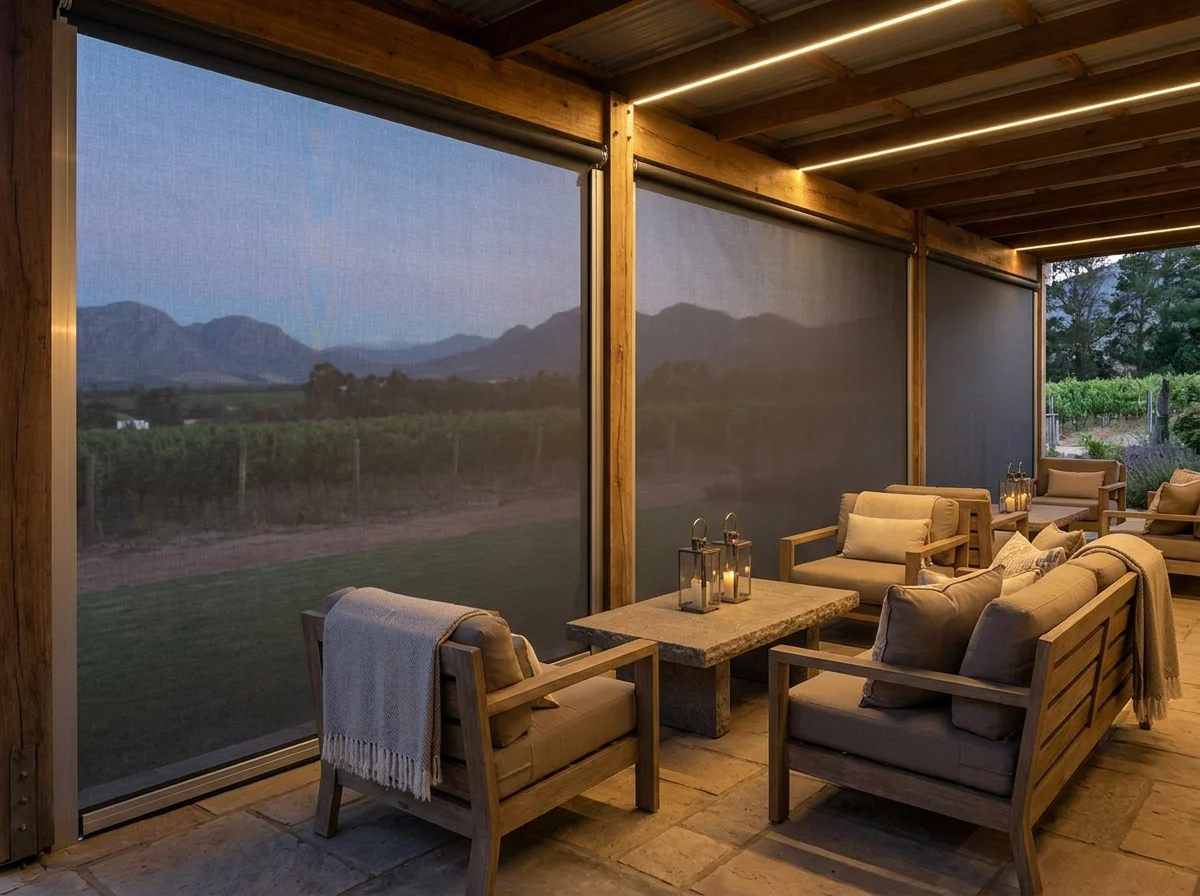
The fabric edge is welded into a zipper that runs captive in aluminium side channels — no flapping, no gaps, real resistance to wind. An ordinary drop screen flaps and escapes its guides the moment a gust hits; a zipped screen holds tension through exactly the kind of mountain-funnelled gust this valley produces on its stillest, hottest afternoons.
Motorisation is standard on wider spans, and a wind-sensor retract is worth specifying on any exposed stoep here — the same funnelled gusts that argue for a wind sensor on an awning apply just as directly to a screen. Spans run wide (4m-plus class per screen), and channels are colour-matched to the structure rather than left as a stock finish.
Entertainment decks on the newer wine-estate homes near Groot Drakenstein and open, less-sheltered stoeps out toward Simonsvlei are where these do the most work — both sit further from any windbreak of trees or neighbouring buildings than a town garden would.
Zip screens are rated on screen area, fitted and working. Manual: R2,800 to R4,500 for a square metre, with the mesh and the height of the drop deciding where an opening lands. Motorised: R4,000 to R6,000, which is where most stoep enclosures end up once the openings run past head height.
A narrow screen still needs its own side channels, headbox and fixings, so small openings carry a minimum rather than pricing down in proportion. The rates size up a project; each opening is measured and quoted on its own, on paper, before anything is ordered.
Ready when you are
Send the form and one of our expert consultants will contact you shortly to arrange your free in-home measure.
Request my call-back →| Best for | Exposed stoeps, entertainment decks and enclosed patios |
|---|---|
| Wind or weather | Edge-locked against gusts; wind-sensor retract on exposed sites |
| Light control | Sunscreen mesh, clear PVC panels or blockout |
| Operation | Motorised as standard on wider spans |
| Privacy | Mesh gives daytime privacy from a farm road or working neighbour |
| Care | Keep channels free of harvest dust; wipe mesh and clear panels |
Zip screens. The difference from an ordinary outdoor drop blind is at the edges: the fabric is held along its full height inside aluminium side channels, so it stays under tension and a gust has no loose side to catch. Out on the valley floor, and especially on open ground such as Simonsvlei where no ridge breaks the wind, that is the dependable option. A wind-sensor retract is still worth having, because every screen has a wind limit, and nothing outdoors is left down overnight by habit.
Choose by season of use. Sunscreen mesh is the summer fabric: it keeps the vineyard in view, cuts glare and ultraviolet, keeps insects out and lets air move, and it screens the stoep from a farm road by day. Clear PVC panels are the winter choice, making a wind and rain-proof room for a braai while the view stays completely open. Some stoeps mix them, mesh on the sunny side and clear panels on the weather side. A blockout cloth is the specialist option for hard west sun.
Yes, and at Klapmuts that is often the main reason for fitting one. Where a stoep looks onto a working neighbour, a light-industrial plot or traffic from the interchange, it wants closing in as much as shading. Because the fabric runs captive in channels down both edges, the side of the stoep comes down as one solid piece and does not hang loose in the opening. Mesh gives daytime privacy while still letting you see out, and harvest dust stays largely on the outside of it.